AI development
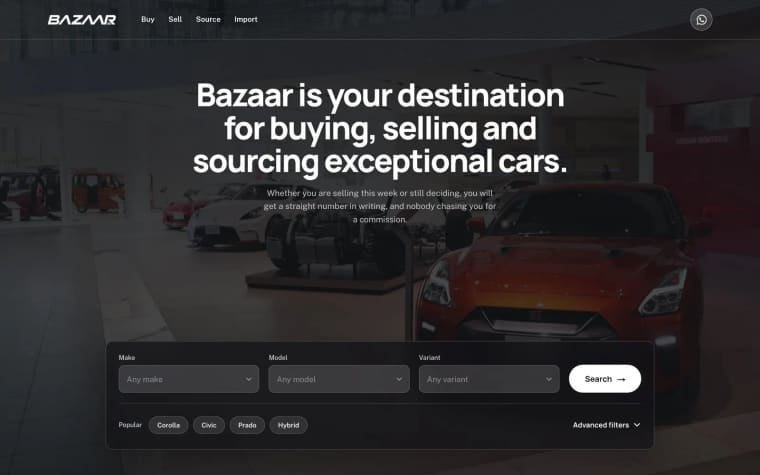
AI development at Atomatify means putting a language model to work inside real software: an LLM app that answers from your own documents and data, a pipeline that pulls fields out of documents and sorts them, or a feature inside software your team already works in. Most of the work is not the model call. It is deciding what the model is allowed to see, what happens to its output next, and how you find out that a change has made it worse before your users do. One of the products we have built shows this work: the staff console for Bazaar, a used-car platform, which includes a trilingual AI assistant.
What's included, and what isn't.
- LLM apps with retrieval over your data: answers drawn from your own documents and records rather than from whatever the model happens to remember.
- Document extraction and classification: pulling the fields you need out of incoming documents and sorting them by type, so nobody does it by hand.
- AI features built into the software your team works in, such as an assistant that is part of a staff console, rather than a separate tool your team has to remember to open.
- LLM integrations, and custom models where the task calls for one.
- Evaluation harnesses and quality gates, so a change to the prompt, the data, or the model is scored against real cases before it ships.
- Training a foundation model from scratch. That is a research lab's budget, not a software team's.
- AI strategy decks and workshops with nothing built at the end of them.
- A promise that the model will never be wrong. We build the checks that show how often it is, and what the software does when it is.
This work, with the numbers.
Hear it from them, not from us.
Real clients, on camera, on what we built and how it landed.
The team is highly skilled and guides in absolute detail. Highly recommended.
Top-notch communication, and they deliver excellent, quality services.
Questions about AI development.
How is this different from your chatbots service? +
We built our app with an AI tool. Is this the right service? +
Can you add AI to a product we already have? +
Which model do you use? +
How do you know it is working? +
Let's build something you can run your business on.
An automation, a new app, a website, an AI feature or chatbot, or a rescue: start with a call. Tell us the problem; we'll tell you the smartest way to solve it.
What happens on the call Thirty minutes. You describe the problem and the stack. We tell you what we'd build, roughly what it costs, and whether we're the right fit. If we're not, we'll say so.